
Morse Decoder
Paste dots and dashes to read them, type text to encode it, or tap Morse on the key below and watch it decode as you go. The decoder follows the international Morse code standard, plays the signal as audio or a flashing light at the speed you choose, and exports a WAV file for practice.
- Free to use
- No sign-up
- Runs in your browser
Morse code decoder and translator
Tap to decode
Press and hold the key (or the spacebar while the key is focused): short = dot, long = dash. Pauses separate letters and words. The speed setting above sets the timing.
Morse Code Learning Pack
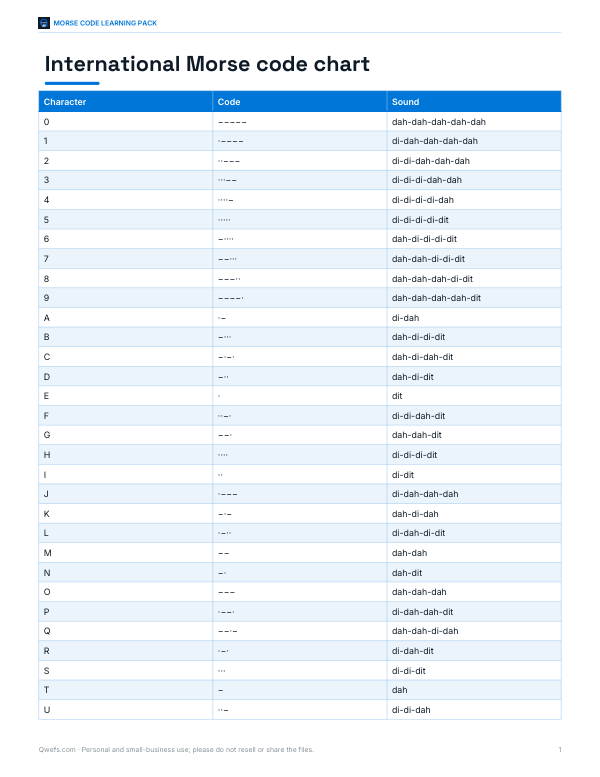
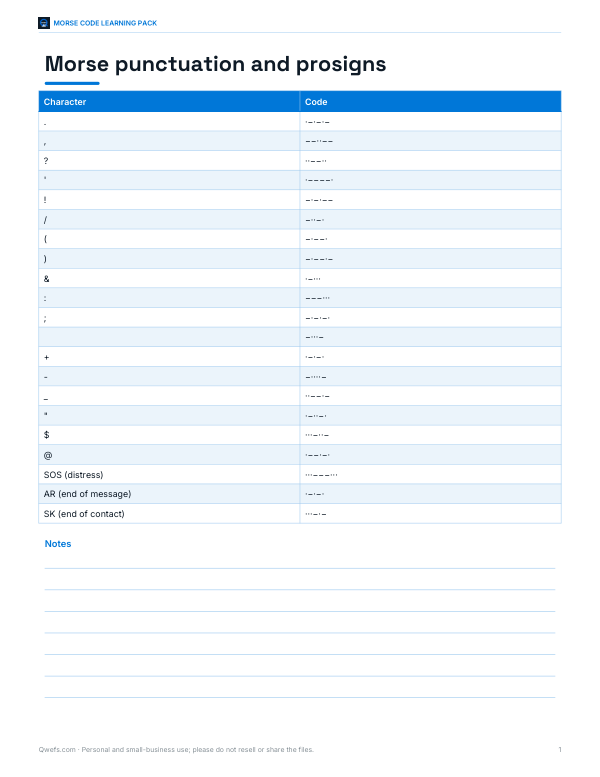
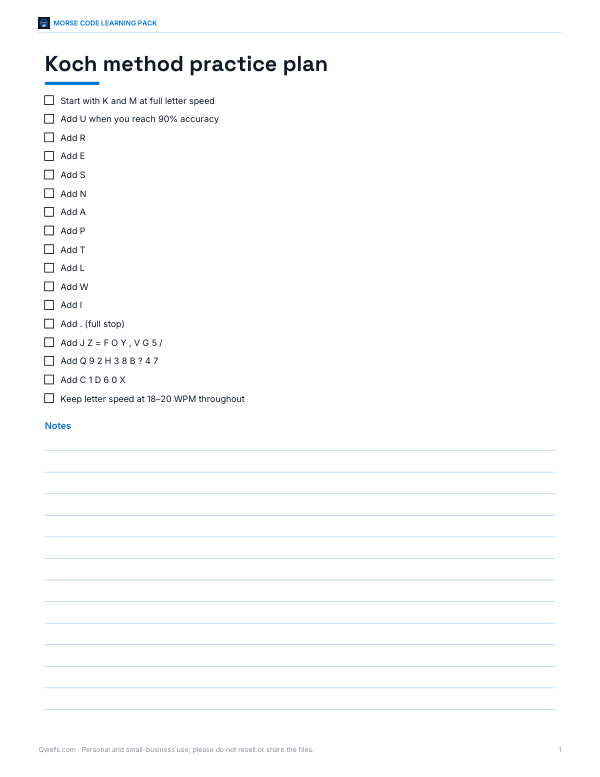
Printable Morse code learning set: alphabet chart, numbers and punctuation card, Koch-method practice plan and decoding practice worksheets with answer keys.
- Alphabet chart (PDF/XLSX)
- Punctuation card (PDF)
- Practice plan (PDF/DOCX)
- Practice worksheets (PDF/DOCX)
Formats: PDF, XLSX, DOCX. Instant download after payment (link valid 72 hours, up to 5 downloads). AI-assisted: the templates were drafted with AI help and reviewed and laid out before publishing.
$3.00 USD, one-time 4 files · about $0.75 each
- Instant download
- 7-day refund
- Secure checkout by Stripe
7-day money-back guarantee. Full refund within 7 days of purchase, even after you download.
Free sample: Koch Practice Plan (PDF, 54 KB)
Full refund within 7 days — see the refund policy and license.
Free printables
Single sheets you can print right now, no sign-up. The full pack adds every sheet in one download plus the editable files.
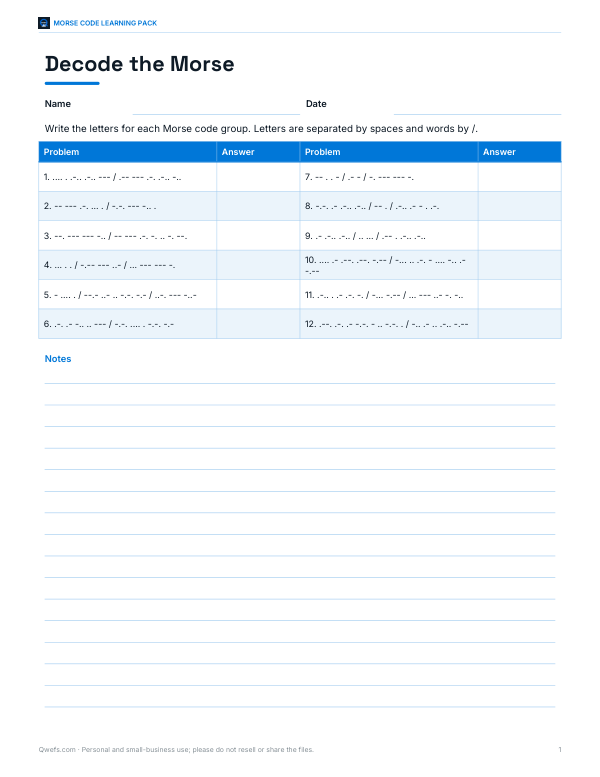 Printable Morse Code Decoder Worksheets
The international Morse code alphabet
| Letter | Code | Letter | Code | Letter | Code |
|---|---|---|---|---|---|
| A | ·− | J | ·−−− | S | ··· |
| B | −··· | K | −·− | T | − |
| C | −·−· | L | ·−·· | U | ··− |
| D | −·· | M | −− | V | ···− |
| E | · | N | −· | W | ·−− |
| F | ··−· | O | −−− | X | −··− |
| G | −−· | P | ·−−· | Y | −·−− |
| H | ···· | Q | −−·− | Z | −−·· |
| I | ·· | R | ·−· |
Digits all have five elements: 1 is ·−−−−, 2 is ··−−−, up to 5 as ·····, then 6 is −····, through to 0 as −−−−−. Common punctuation includes the full stop ·−·−·−, comma −−··−− and question mark ··−−··.
Timing rules
| Element | Length |
|---|---|
| Dot (dit) | 1 unit |
| Dash (dah) | 3 units |
| Gap within a letter | 1 unit |
| Gap between letters | 3 units |
| Gap between words | 7 units |
Speed is measured in words per minute (WPM) using the standard word “PARIS”, which is exactly 50 units long including the word space. So one unit lasts 1,200 ÷ WPM milliseconds: 60 ms at 20 WPM. Farnsworth timing keeps the letters at a faster speed but stretches the gaps between them, which helps learners recognise each letter by its sound rather than counting dots and dashes.
How to read Morse code you’ve written down
- Separate letters with single spaces and words with a slash or three spaces.
- Use a full stop or middle dot for dots and a hyphen or dash for dashes — the decoder accepts all of these.
- Paste into the Morse box; the text appears instantly.
- Groups the decoder can’t match show as �, which usually means two letters ran together without a space.
Worked example
The default message “... --- ... / .-- . / -. . . -.. / .... . .-.. .--.” decodes as SOS WE NEED HELP. At 18 WPM with Farnsworth spacing at 12 WPM, a dot lasts 67 ms and the whole message takes around 11 seconds to send. SOS itself is traditionally sent as a single run — ···−−−··· — without letter gaps, which is why the decoder also recognises the unbroken nine-element group.
Decoding by tapping
The tap key turns your presses into dots and dashes using the speed setting: presses shorter than two units count as dots, longer ones as dashes. A pause of more than about three units ends a letter and a longer pause ends a word. If your letters keep merging, lower the WPM so the decoder expects longer gaps; if dots are read as dashes, raise it. Beginners often find 10–15 WPM comfortable for sending by hand.
Learning Morse code
- Learn by sound, not by looking at charts: “di-dah” for A, “dah-di-di-dit” for B.
- Start with Farnsworth timing — letters at 18–20 WPM, overall speed around 10–12 WPM.
- The Koch method introduces two letters at full speed, then adds one letter at a time once you reach about 90% accuracy.
- Practise for 10–20 minutes daily rather than long sessions.
- Use the WAV download to practise away from the computer.
Where Morse code is still used
Amateur radio operators use Morse code (called CW, for continuous wave) because it gets through weak and noisy conditions where voice fails. Aviation navigation beacons still identify themselves in Morse, and pilots check the identifier. It is also used as an accessibility input method for some people with limited mobility, and in escape rooms and puzzles. Knowing SOS (···−−−···) and how to signal it with a torch is a useful emergency skill.
Signalling with light and sound
Morse code works with any on–off signal: a torch, a car’s headlights, a whistle or tapping on a pipe. The light button above flashes the message on screen so you can practise reading visual signals, and the same timing rules apply — keep dots short and crisp and leave clear gaps. At night, a phone torch can be seen at a surprising distance; hold it steady and point it towards the receiver. For sound, a lower tone around 500–700 Hz is easiest on the ears for long practice sessions.
Common decoding mistakes
- Missing letter spaces: ·− ·−·· (A L) run together becomes ·−·−··, which is not a letter.
- Confusing mirror letters: A (·−) and N (−·), D (−··) and U (··−), G (−−·) and W (·−−).
- Counting dots at speed: above about 10 WPM, recognise the rhythm of the whole letter instead.
- Mixing up the zero (−−−−−) and the letter O (−−−).
- Forgetting that numbers always have five elements.
A little history
Samuel Morse and Alfred Vail developed an electric telegraph code in the 1830s and 1840s. The version used today, international Morse code, was standardised in Europe in the mid-1800s and differs from the original American Morse code in many letters. Morse ceased to be required for maritime distress communication at the end of the 1990s, when satellite-based systems took over, but it remains popular among radio amateurs worldwide.
Frequently asked questions
How do I decode Morse code?
Paste the dots and dashes with spaces between letters and / between words; the text appears automatically.
What is SOS in Morse code?
··· −−− ··· — three dots, three dashes, three dots, usually sent without gaps.
How fast is Morse code?
Beginners send at 5–15 WPM; experienced operators often 20–30 WPM or more.
What is Farnsworth timing?
Letters sent at a faster speed with longer gaps between them, to help learners hear each letter as a whole.
Can I download the audio?
Yes — Download WAV saves the current message at the chosen speed and tone.
Is it international or American Morse?
International Morse code, the standard used today.
Why does my tapped code decode wrongly?
Adjust the WPM setting to match your tapping speed so the decoder can tell dots from dashes and letter gaps from word gaps.
How do I write a space in Morse code?
Leave a gap of seven units; in written Morse, use a slash / or three spaces between words.